Frank Moorhouse was on the periphery of my life.
In 1988 I moved to Nowra, Frank’s hometown when I married his nephew, Steven Moorhouse, and joined the Moorhouse clan. Arthur Moorhouse, Frank’s brother is Steven’s father.
I was a young woman entering the Moorhouse family, not yet a mother nor a psychologist but I was busy becoming both. Birthdays and Christmas included Frank and Arthur’s parents, Purthanry and Frank senior who warmly welcomed me into the family. I did not pay much attention to the fact that Frank and the oldest brother Owen were not at family events. Indeed I did not meet Steven’s cousins, Owen’s children, until much later in my life.
Slowly Frank became this mysterious person to me. He was part of the family but rarely spoken about or seen. I knew that he was a renowned author and as an avid reader, it was not long before I was drawn to his books, starting with the Electrical Experience. My mind exploded because surely I was reading about our family! T. George McDowell, the central character in the Electrical Experience had to be based on Frank senior, who was also an electrician, business owner, pillar of the community, avid Rotarian, and living on the South Coast. Was the conflict T George McDowell experienced with his daughter reflective of his relationship with Frank?
How were these weird, wonderful, sexually explicit, utterly compelling stories born of this conservative and traditional family in this small country town? I never heard Frank’s parents speak about his books, and I do not know if they read any of his work. Oh, how I wished I’d asked them.
Arthur tells me Frank senior would describe the books as “earthy” and that Purthanry never spoke of them however she kept a stash of newspaper clippings from whenever Frank was featured.
Steven recalls his parents had a copy of the American’s Baby, bound in brown paper in his home. It seems like shame and pride lived side by side in the family’s relationship with Frank, a difficult space for all to navigate.
We moved far from Nowra and we saw very little of Frank, though we have a signed copy of Loose Living from 1995 which I vaguely recollect him giving to us when we were visiting one Christmas.
Steven gifted me The Inspector General of Misconception when I obtained my Australian Citizenship in 2002 – writing “what better way to start your Aussie life”. There was Frank again, of my life, but not in my life.
 Connecting with Frank Moorhouse
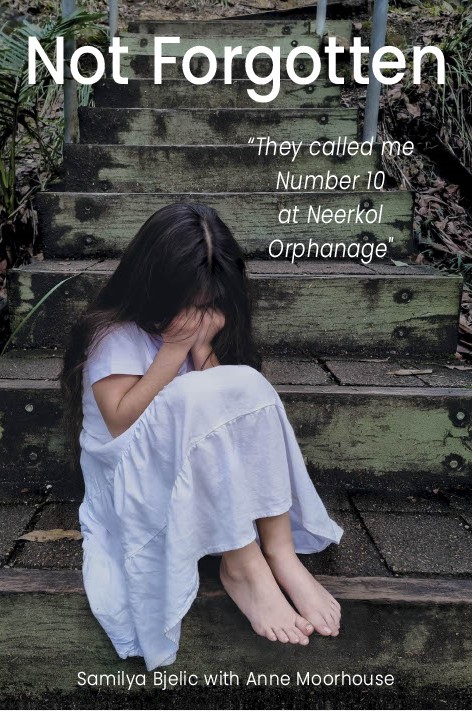
Our connection to Frank strengthened when I wrote Not Forgotten: They called me Number 10 at Neerkol Orphanage. Arthur insisted that I send Frank the manuscript for review. I was reluctant to impose on this literary great and elusive uncle, and also fearful of the feedback I would receive. Arthur rang Frank in my presence and told Frank that the manuscript was on its way. I couldn’t back out. I doubt that I would have sent it without this push, and am so grateful to Arthur.
Frank’s generosity both humbled and emboldened me. He read the manuscript quickly, taking time to point out errors and discrepancies. Frank rightly questioned my futile need to create a rosy ending. He supported and encouraged me and then he referred me to his agent!
Dear Jo, as you know I am very careful about who I recommend to the Agency.
I rarely read manuscripts that are sent to me or when I am asked to read them — even by friends, especially friends.
But my niece-in-law Anne Moorhouse who is a therapist psychologist asked me to read this rather unusual non-fiction book Number 10 from Neerkol and I agreed to do so.
I have now read it and think that this could be a very important book.
It tells the story of Samilya, an orphaned and abused child, and her attempts throughout her life to find stability and peace with herself, to raise a family, and to gain compensations for her abuse. It is told partly by Anne and partly by documents, diaries, blogs, letters, and the words of Samilya herself and those around her.
I feel that it is powerful, well-constructed, affecting, but at times, gruelling, and, it is, of course, timely.
Would you be prepared to read it and consider it for publication? If so would you like the entire ms or the usual three chapters?
Very best, Frank
Frank warned me that his name would both open and close doors for me. Sadly, despite being recommended by the great Frank Moorhouse, and some initial interest I did not find a traditional publisher. I self-published, entering a literary world unknown to Frank. Frank’s recommendation kept me going and I repeatedly read his email, and others he sent when I lost hope. I told myself if Frank thought it was worth publishing, then I should do it. In 2021 I proudly sent Frank a copy of my book.
 Franks Memorial
Frank’s life was remembered and celebrated by his family and friends at the State Library of New South Wales on 13/7/2022. I wonder what Frank would have thought of this coming together in his death of the many people who had loved him. In his life, he had kept family and friends separated.
As I listened to his friends speak I realised how little I knew of this complex man, and wished I had enjoyed more time with him. His friends spoke of his generosity to writers which I had experienced. They spoke of his boldness, curiosity, humour, and dedication to his craft which is evident in his work. They highlighted his advocacy for copyright laws to ensure that Australian creators receive royalties for the copying and sharing of their work.
Family and friends spoke of Frank’s love for the bush and his habit of taking himself off, often alone, for extended periods of time. I remember Arthur worrying about Frank during the sojourns to the bush. He was always relieved to know Frank had returned. Frank’s ashes will be scattered in his beloved Budawang Range.
The memorial speeches were bookended by two great men. Firstly Arthur Moorhouse, grieving and loving older brother, reflected on the lives of three boys together in Nowra and the early days of Frank’s career. Tom Keneally, Australian novelist, playwright, essayist and actor paid homage to Frank’s literary legacy and noted that Frank’s courage had changed not just the literary landscape of Australia but that he had also been a trailblazer for LBGTIQ+ understanding and acceptance in Australia.
All spoke of Frank’s love of long lunches and martinis. A few years ago we’d joined Frank for a long lunch at his beloved Automobile Club.
The Moorhouse Martini
So I’ll finish now and let you wander off to make a Moorhouse Martini. The recipe was sent to me by Frank’s niece, Karin Moorhouse. Karin also experienced Frank’s generosity to writers when she wrote No One Can Stop the Rain.
Here it is! …the recipe for Frank’s famed “Moorhouse Martini 🍸 “.
It once appeared on the bar menu at Bayswater Brasserie in Kings Cross, once a favourite lunch venue of Frank’s.
The Moorhouse Martini:
2 parts gin (London Dry Gin, or Bombay Sapphire)
0.5 parts dry vermouth (Noilly Prat)
Green olive on a toothpick
The trick is to make sure the glasses are kept in the freezer until the moment of pouring. Use ice in the cocktail shaker. As cold as possible.
Sometimes he liked a “dirty martini.” Just add one or two teaspoons of olive juice to the glass after pouring.
Vale Frank Moorhouse and thank you.
Like this:
Like Loading...

 The oldest boy is my great-nephew. He is my sister’s grandson, visiting from New Zealand with his parents for a lovely long weekend of family connection and to join our annual Christmas Carols extravaganza. I visited my sister in New Zealand in January 2025. At 79 years old, she was living at home with her husband, and while she seemed somewhat withdrawn and a little confused, life was much like it had been for many years. I had an underlying sense of disquiet and gently encouraged her to talk about death and dying with her children. By May, everything had changed, and we found ourselves revisiting New Zealand. This time, my sister was living in an aged care facility and did not know who I was. She was frail and unable to walk. She will never watch her grandson curiously adventuring in her backyard or hear his yelps of delight.
 An ordinary day, but not an ordinary moment. It’s a moment heavy with meaning—a snapshot of family history, love and loss. A moment that rewards every effort to show up for these children, and honours the trust their parents place in us. A moment that whispers: This is what matters.
 In Thailand and Cambodia people make offerings to spirits every day to create positive karma. We, as tourists, must have been included in their wishes for happiness and well-being as we’ve had a fortuitous trip.
 We anticipated a spectacular but busy day at the Grand Palace as we joined the throng of tourists channeled through the entrance gates. We followed the crowds along the designated path to the resplendent buildings. Pausing to gain our bearings we found ourselves in front of a small sign offering a “Free English Tour at 10.30 am”, it was 10.27 am. Our unplanned morning allowed us to be here at exactly the right time and place. There were thousands of people visiting the Grand Palace that day but we joined a group of just three others. We enjoyed a funny, informative tour, with a guide who spoke excellent English and happily answered our questions.
 We had no idea Chiang Mai held a spectacular annual flower festival for three days in February. On our second morning in Chiang Mai we caught a glimpse of one colourful exhibit as we drove past on our tour. After discovering it was the last day of the festival, and although we were hot and bothered that evening, we dragged ourselves along to Suan Buak Haad Public Park. There we were treated with an exotic array of 25 large parade floats ornately adorned with flowers, petals and plants. It was an elaborate celebration of botany, art and culture.
 We gladly accepted the invitation to go to Koh Samui with our daughter-in-law, son and grandson where we would be joined by three of her sisters from England. With their partners and children we would become a party of 15. We built our trip to Thailand and Cambodia around the week we would meet the family.
 The Giant Puppet Project, Siem Reap
 There was one offering I should have refused. A tour in Chiang Rai included a trip to the village of the long-necked Karen people. These colourfully dressed tribal women traditionally wear heavy metal rings around their necks. As refugees from Myanmar they have no right to work, education or health care in Thailand. We paid a fee to enter the village and the women sat outside their shops posing for photos.
 Ten days later in Siam Reap, a sign on the back of a toilet door in
  Our Cambodian bike tour included a visit to Angkor Wat at sunrise. Despite the allure of the event, I dreaded the 4.40am pick up. For a night owl like me that’s torture. I tiredly sat in the dark waiting for the sunrise and was blessed to see it gently rise behind one of the most spectacular buildings on the planet. The following day our guide emphasised how lucky we were, as for weeks prior the sunrises had been consistently dulled due to cloud cover.
 This month, I’ve spent hours talking with friends and family about getting old and dying. It’s such a fun topic when you’re on holiday. Yet, discussing ageing and death is now part of the narrative of my life. At 68, if the media interviewed me, I would be considered an “elderly retired grandmother”. Not that I feel like that. When I was a young mum, I talked about babies and toddlers. Then I lamented with anyone who would listen about wayward teenagers. After those teenagers became adults and left, I discussed work. Now that I’m retired many conversations are around planning holidays, grandchildren, the state of the world, getting old, and death. It’s a bit like the
  My 92-year-old father-in-law and 90-year-old mother-in-law live independently in their family home. They have made some alterations like adding a step elevator for the front steps and installing grab rails and a bidet in the bathroom. They have help in the garden and a cleaner. Their home remains perfect for them, close to family and the community they have lived in all their lives. However, I decided I needed to move after falling down my
  It’s unimaginable that I won’t be able to make decisions for myself, but I have seen the consequences of not planning for this possibility. At 65 years old, a friend had a stroke and was unable to make decisions for himself. After an initial hospital stay, he was moved to an aged care home. His family and friends had to make an application to the Guardianship and Administration Tribunal, so a guardian to manage his affairs could be appointed. Until this happened no major decisions could be made about his assets, and funds needed for his care were limited. My friend also had to be medically assessed as not having the capacity to make important health and personal decisions as evidence for the tribunal. These stressful and lengthy medico/legal processes would have been avoided had he prepared an Enduring Power of Attorney when he was well.
  We all have “stuff”. It seems to accumulate no matter how many clean-outs we have. Some of that “stuff” is valuable, like your home, financial investments and other assets. I’m sure family and friends will select sentimental mementos when I’m gone, but they won’t want most of my chattels and I’m ok with this. However, although I plan to spend as much of my money as I can before I die, I do want to choose who will receive any remaining financial assets. The best way I can ensure this will happen as I wish is to make a Will.


 Leo lifts the brass latches of the 100-year-old cabin trunk, opens the lid and climbs inside. At 18 months old Leo is unaware that the trunk belonged to his great-great-grandmother Purthanry Thanes Mary Cutts. While he explores, I run my hands gently over the aged leather lid and embellished corners, allowing myself to daydream of luxurious travel aboard a grand cruise liner.
 I met Purthanry, my husband’s paternal grandmother when I was 30 and she was in her 80’s. Like the trunk, she had an aura of elegance and sophistication which I found somewhat intimidating even as she welcomed me warmly into the family. I was unaware of the trunk until after her death. Then I coveted it. The trunk is a precious family heirloom and a connection to my
  Purthanry had returned home by 1928 when she married Frank Moorhouse at 27. Purthanry, a Girl Guide Captain, and her Guides, approached Frank at Mosman ferry wharf while selling tickets to a ball. Initially Frank refused the tickets as he did not have a partner, however, the resourceful Guides assured him they could organise the perfect date. Purthanry and Frank attended the ball together.
 The couple moved to East Street, Nowra, living in a home they called Amaroho. Some of Purthanry’s first acquisitions were a beautiful dressing table and chamber pot commode cupboard which stayed with Purtharny until her death at 95. When I received the cabin trunk, my son and his English wife took possession of the dressing table and cupboard which are now part of Leo’s daily life. Arthur remembers his mother brushing her long hair at the dressing table. She always tied her hair up in a bun. Purthanry dressed formally with minimal makeup and never wore trousers or shorts.


 Remember those first weeks of lockdown early in 2020, before we got jaded and screened out? That’s when it was still fun to do zoom calls. I hadn’t yet done 8 weeks of telehealth as a psychologist and
  The impact of the pandemic hit my son and his fiancé with an unexpected ferocity. She was unable to return to the UK for her mother’s funeral and her sister’s wedding was cancelled. The ease of living overseas, where a trip home is just a day and some hard earned money evaporated overnight. If she went home for the funeral, she would not be able to return to Australia. I’m so glad she stayed. I’m also glad they had travelled to see her mum when she was ill earlier in the year.
 I worried more as I stitched this wreath. My daughter and her partner were locked down in Melbourne. Basically they’d been in lockdown since 21 March 2020 and restrictions didn’t begin to ease until November 2020. I worried about their mental health, their relationship and their jobs. While they found it tough they also flourished creating art, furniture and gourmet meals. They embraced a buy local strategy and our birthdays were celebrated with bundles of gifts found within a 5 km ring of where they lived.
 This wreath is for Ms Forgotten Australian’s youngest daughter’s family who hold a special place in my heart. The family underwent 4 Covid tests this year, whereas I had none. Like any family, the kids, 4 and 6 years old, bought home coughs and colds which resulted in multiple tests. I don’t know any child who looks forward to having a stranger stick a swab up their nose! It takes fortitude and integrity to turn up for yet another Covid test with fearful children, who probably just have a cold.
 Our nephew, his pregnant wife, their 9 month and 4 year old daughters started the year living with us as they made the move from Sydney to Brisbane. Then they bought a new home, he started a new job, she upstaged him by giving birth to a new baby girl during Covid, and of course were separated from interstate family. Its been lovely watching their excitement and joy at each new adventure. As they hang their wreath each Christmas, I’m sure they will remember the many new beginnings of 2020, not just that they lived through a pandemic.

 We celebrated my brother’s 60th birthday with
  Keeping my body active will be more of a challenge. Despite this bike trip, and that I also rode the
 It’s Mother’s Day this Sunday in Australia. A day when many families come together to rejoice in the loving bond between mothers and children. A day to celebrate the blood, sweat and tears that ooze out of mothers while raising children. But for some families, it’s a day of heartbreak. There will be no bunches of flowers or boxes of chocolates. Adult children and parents can become estranged to each other. That’s tough.