Leo lifts the brass latches of the 100-year-old cabin trunk, opens the lid and climbs inside. At 18 months old Leo is unaware that the trunk belonged to his great-great-grandmother Purthanry Thanes Mary Cutts. While he explores, I run my hands gently over the aged leather lid and embellished corners, allowing myself to daydream of luxurious travel aboard a grand cruise liner.
 I met Purthanry, my husband’s paternal grandmother when I was 30 and she was in her 80’s. Like the trunk, she had an aura of elegance and sophistication which I found somewhat intimidating even as she welcomed me warmly into the family. I was unaware of the trunk until after her death. Then I coveted it. The trunk is a precious family heirloom and a connection to my love of travel. It took 20 years for Purthanry’s son Arthur, my father-in-law, to bestow care of the trunk to me. Finally, and somewhat reluctantly, he carefully loaded it into his car, drove from Nowra to Brisbane and delivered it.
A ticket to the “old country” and a cabin trunk
The cabin trunk, stamped in gold with Purthanry’s initials and surname, was a 21st birthday gift from her parents, Thomas and Mary Cutts. A return ticket for a sea voyage to the UK accompanied it. For Purthanry, born 3 May 1901, a Sydney girl of convict stock, the trip to the “old country”, England, would have been an exciting and expensive gift. The trunk and voyage marked her family’s success and status.
In 1836 at age 25, John Boden Yeates, Purthanry’s great-grandfather, was transported to Australia for seven years. He was found guilty of stealing a handkerchief from a gentleman’s pocket. The handkerchief was valued at one shilling, about a day’s wages. He arrived in Australia as a manacled prisoner, yet Purthanry departed Australia, less than a hundred years later, as a poised and accomplished young woman.
We know little about the trip except that Purthanry, an only child, travelled to meet her uncle, Frank Cutts, in England. I imagine sharing afternoon tea with Purthanry. She would pour tea from a beautiful floral bone China teapot adding milk from a matching jug. Sitting at her dining room table she would answer all my questions. I long to know what she packed into that trunk and whether a chaperone accompanied her.
Looking through the mirror of the past
 Purthanry had returned home by 1928 when she married Frank Moorhouse at 27. Purthanry, a Girl Guide Captain, and her Guides, approached Frank at Mosman ferry wharf while selling tickets to a ball. Initially Frank refused the tickets as he did not have a partner, however, the resourceful Guides assured him they could organise the perfect date. Purthanry and Frank attended the ball together.
 The couple moved to East Street, Nowra, living in a home they called Amaroho. Some of Purthanry’s first acquisitions were a beautiful dressing table and chamber pot commode cupboard which stayed with Purtharny until her death at 95. When I received the cabin trunk, my son and his English wife took possession of the dressing table and cupboard which are now part of Leo’s daily life. Arthur remembers his mother brushing her long hair at the dressing table. She always tied her hair up in a bun. Purthanry dressed formally with minimal makeup and never wore trousers or shorts.
Purthanry worked alongside Frank as he set up his business Moorhouse the Machinery Man. She had three sons, Owen, Arthur and Frank. Arthur recalls her closest friends were single women, referred to as “old maids”. An Aboriginal housekeeper, Belle Brown cared for the family.
Purthanry dedicated her life to the community including the Girl Guides, Country Women’s Association, Red Cross, Crippled Children’s Association, Church of England, and as a Rotary wife (women were not allowed to be members at that time). In 1990 Purthanry received the Order of Australia for service to the community. She also received a Shoalhaven Citizen of the Year Award and the Paul Harris Fellowship Award for her contribution and dedication to Rotary.
Purthanry continued to travel, often to international Rotary conventions, albeit without her cabin trunk.
Where will life take you Leo?

Postscript:
After I posted this blog I received further information from Owen Moorhouse, Purthanry’s oldest son who is now 95.
Dear Anne
Thanks for the travel trunk story (also called Cabin Trunk). The trunk took Mum to London by RMS Oronsay Passenger Liner, a 6-week trip. She stayed with GrandPa Cutts’ sister, Aunt Polly. Aunt Polly was a trained nurse of the Florence Nightingale school.
Mum couldn’t have chosen a more disadvantaged time to visit Britain. Winston Churchill had recommended a return to the gold standard (a monetary system in which the value of a country’s currency is directly linked to gold) . This increased the value of £STG which devalued the £AU The £STG increase made British goods dearer which in turn put many out of work. Overall, it produced a difficult financial situation for colonial visitors.
Owen

 The theme of the festival is Growth and Resilience and I’m excited to share how, as a novice writer, I fought through the frustrations I experienced while writing

 It was quiet in the practice on Wednesday evening, some of my colleagues were away, and others were working behind closed doors. I finished my last session at 7 pm, closed my trusty laptop, picked up my raggedy pad with scrawled notes, untangled the cords to my old-fashioned earphones, and packed my bag. Took my favourite green teacup to the kitchen, said goodnight to Millie who was managing the reception desk and slid out the backdoor.
 My son, daughter, and daughter-in-law celebrated my retirement by gifting me a bottle of vodka, Bloody Mary mix, lemon juice, a glass, and PJs. The Bloody Mary tradition was born while living in Papua New Guinea for eight years. I would board the plane to leave and order a Bloody Mary. It’s become our family marker of travel and transitions. Is this what they think I’ll be doing with the rest of my life?
 yton later told me she felt great pride and satisfaction in being able to bring my image to life, knowing Samilya and I could now hold our book in our arms with the burst of pride I had hoped for.


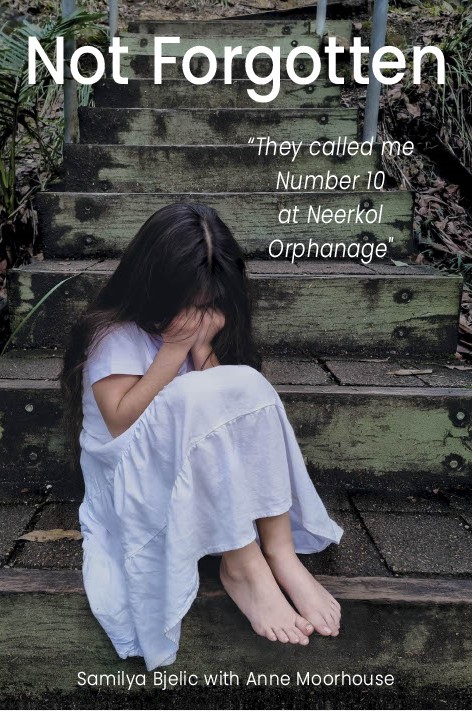
 With both trepidation and excitement, Samilya and I launched our book Not Forgotten: They called me number 10 at Neerkol orphanage at
  The launch took place after the volunteers monthly lunch. Before we even had the books ready for sale we were besieged by Samilya’s colleagues and friends wanting a copy. Everyone clamoured for Samilya to sign their copy.


 There is no real privacy.

 By the time I’d been operated on and reached home a day later, I’d been offered a number of mobility aids: wheelchairs, knee scooters, crutches, hoppers and bath stools. I didn’t need the crutches as a friend with five sets lent me a pair.
 I’m a strong advocate of laughter as part of healing and this card provided a belly laugh. It may well be the best card I’ve ever received.
 It’s going to be a tough 6 weeks, managing without putting any weight on my right leg, but its already been made much easier through the help of friends, neighbours, colleagues and strangers. I’m well on the way to recovery.
 You came quietly into my counselling room, looking a bit unsure, eyes cast downwards. Hesitant to speak.
 You left the GP with a Mental Health Care Plan for 6 sessions, a bit surprised to learn that they’re not free because most psychologists can’t afford to bulk bill. Ouch, this is more expensive than you anticipated. You also learned that you can only have 10 Medicare subsidised sessions each year. Still, you think, 10 sessions must be enough for the psychologist to “fix” you. Why else would they only give you this many? It seemed like quite a lot of sessions at the time.