My gorgeous grandson, Leo, was surrounded by his adoring great-grandfather, grandfather and father. The love for him radiated from these three men. Watching them, I wondered how the experience of becoming a dad had shifted across the three generations.
Arthur (Great Pa, Pa, Dad) – Became a father in 1957 at the age of 25.
When Arthur and I chatted about him becoming a dad, my 92-year-old father-in-law had been married to his wife, Rhonda, for 70 years. He has three children, Greg, Steven and Jenell and has a clear recollection of when his oldest son, Greg, was born.
“Rhonda was in the kitchen when her waters broke, five weeks before the due date. In those days, in a country town, women went to the doctor when they went into labour, not the hospital. The doctor thought not much would happen as the baby wasn’t due but sent Rhonda to the small hospital for a check-up. Rhonda was admitted to the hospital, and I went home to bed. I got up at daybreak and went to work fixing milking machines.
I got back to town at about 10 am. People stopped me in the street and congratulated me on becoming a father to a son, but I hadn’t heard that the baby had been born. I rushed to the hospital. Rhonda was in the ward, and newborn baby Greg was in the nursery. As was common at the time, Rhonda hadn’t been allowed to see Greg since the birth. I went straight to the nursery to make sure he had 10 fingers and toes. He was perfect. I felt like I was the last one in town to know he’d been born.
Rhonda was out of hospital in a few days, but 5 lb premature baby, Greg, stayed in the hospital for about 3 weeks. Rhonda stayed with her mother, who lived close to the hospital, which made it easier for her to walk up and deliver expressed breast milk and see Greg.
I didn’t have time off work when any of our three children were born. Rhonda’s mother helped her. Each baby was taken weekly to the baby health clinics operated by the Country Women’s Association.
I did change nappies, and you flushed them in the toilet for the initial clean. You had to hold on tight to the corner, so you didn’t lose them and block the drains.”
The couple were 22 and 25 years old when they became parents. They lived in their own home, which Arthur was building around them. Rhonda described Arthur as “working from daylight to dark”.
Steven – (Poppy, Dad). Became a father in 1987 at the age of 28.
Next came my husband, Steven, Arthur’s second son. He described his experience of becoming a dad when our son Mark was born. My mouth was firmly shut and did not prompt him, because I was there too, but this was about his experience.
Steven with baby Mark. Day 1 of becoming a dad
“I first found out I was going to become a dad through a home pregnancy test.We did two of the tests just to be sure. This was something we had planned and were both very excited and a little surprised that it hadn’t taken us long to get pregnant.
We went to childbirth classes for a few weeks, and the most important thing I learnt was the importance of being there as a support to Anne, and that I wasn’t the one having the baby.
Anne went into labour in the evening. Through the early stages of labour, she was getting in and out of the shower; she seemed very capable and confident. I was timing the contractions throughout, as we didn’t want to go to the hospital too soon. On the flip side, we didn’t want to leave it too late either. I don’t remember being worried, but I was certainly a bit scared; I’d never done this before.
I drove us to Nowra hospital, where I had also been born. The labour bag was packed, and we were prepared. We were ushered straight to the blue birthing room. The nurses examined Anne and found she was only 5 cm dilated; this was a little disappointing as we had expected her to be further progressed. It seemed like there was still a long way to go.
I continued to help Anne in and out of the shower at the hospital, rubbing her back and holding her hand. The labour went on for hours, with Anne eventually having an epidural. I didn’t want to see her hurting, but I also knew she wanted the birth to be as natural as possible.
When the baby was crowning, the doctor asked if I wanted to look. Of course I did, but what I saw made me go weak in the knees, almost fainting. I quickly retreated and sat back down at Anne’s head.
We were thrilled to hear the Doctor say, “It’s a boy”; we had chosen not to know beforehand. Our healthy son Mark was wrapped in a blue blanket and handed to Anne. I cried happy tears of joy and relief.
There were no mobile phones in those days, so I drove over to tell Mum and Dad the exciting news, had a shower and went back to the hospital. Anne and Mark were home in a couple of days. I think I had a week off work.
Having a new baby was scary; I was particularly scared of jabbing him with a nappy pin, dropping him in the bath or knocking the umbilical cord wound. I did everything I could to help.
I remember we had a big yellow nappy bucket in the bathroom. As Dad said, you flushed the dirty cloth nappies in the toilet first, holding on tight not to lose them, then soaked them in the nappy bucket until you washed them.
Mark slept in a bassinet in our room. I was aware that the baby was not allowed to sleep in our bed, and I was scared of squashing him when Anne breastfed him in bed.
Mark met two great-grandmothers and his great-grandfather in the first week of his life.
It was an amazing, wonderful thing to witness this creation of life, so special.”
Steven was 28, and I was 31 when we became parents. We had recently moved to Nowra, where Rhonda and Arthur lived.
Mark (Dad) – Became a father in 2023 at the age of 35.
And the newest dad is Mark – Steven and my son, and Arthur’s grandson. I chatted to Mark about the birth of his son Leo, who is now 3 years old.
Mark with baby Leo. Day 1 of becoming a dad.
“We did IVF to have Leo, so it was a series of interventions and then tests. I was excited and nervous when I found out my wife, Kim, was pregnant. We’d already had a miscarriage.
We went to two birthing courses, one that the midwives ran and the other a hypnobirthing one.
The hypnobirthing course was more about the mother’s rights, how to ask questions and make decisions, rather than go with the whim of the doctors and midwives. I also learnt techniques about how to calm Kim and how to make us feel more connected as a couple.
The midwife course was more about medical interventions like epidurals and continuous fetal monitoring.
Kim went into labour when her waters broke in the morning. She had some contractions, and we went to the hospital in the evening. She got checked, but the contractions were not deemed that serious, and we were sent home.
The contractions went on for another two days, and we checked in at the hospital each day. On the third morning, we went to the hospital, and the decision was made to induce Kim. I’d forgotten the bags we’d packed, so I rushed home again, dropped the dog off with mum and dad and went back to the hospital. I felt silly and was worried the baby would be born before I got back.
We were lucky to be in a birthing room; we had music, diffusers, a mood board, fairy lights and a large exercise ball.
Kim’s contractions ramped up, becoming more intense and consistent. Kim used a TENS machine and gas for pain relief. She kept mobile until contractions became 1-2 minutes apart, then she spent more time on the bed.
I was standing with her, talking her through the contractions, holding her hand, encouraging her, reminding her that the pain was good and healthy.
When she was 8 cm dilated, we knew she didn’t have long to go. About half an hour later, she was ready to push. I was holding her hand and watching. For the first time, she said she couldn’t do it anymore, but you could already see his head. We knew it was going to be a boy.
Cat Stevens “Wild World” was playing when our son was born, and I cut the cord.
The doctor only came right at the end. The labour was managed by midwives.
Leo was born at 8.30 pm. It was a gobsmacking moment, loving. I cried. Kim was amazing.
I stayed until midnight, stopped at Mum and Dad’s to tell them our wonderful news. I was back at the hospital by 6 am. We left that day after all the tests and visits by physios and lactation consultants had been done.
I had six weeks off work when Leo was born, then took another three months off when Kim went back to work when Leo was one.
During those six weeks, I started learning how to be a dad. I changed nappies, bathed Leo and cooked meals. No nappy bucket for us, we used disposables. I made sure Kim was hydrated and fed.
Leo met his grandparents on the first day.”
Mark and Kim were both 35 when they became parents. Living in Brisbane, just 5 minutes’ drive from us. They are eagerly expecting their second son in March 2026.
And now a fourth generation
Three generations of men becoming dads, three very different worlds, and one shared moment: holding their newborn child for the first time.
Now there are four generations who share the middle name Osborne.
I can’t help but wonder what it will be like for Leo if he becomes a father one day.
Whatever the future looks like, I hope he feels what these three men felt — awe, love, and the quiet realisation that life has just changed forever. I hope he and his soon-to-be-born brother continue to feel the legacy of love that these men have bestowed on him.
If you’d told me that one day I’d have a giraffe living in my suburban Brisbane backyard, I would’ve laughed and wondered what on earth you were thinking. And yet… here we are.
Tall Black — my majestic, caffeine‑fuelled, eco‑friendly giraffe — now stands proudly in the garden, shimmering in the sun in his coat of repurposed coffee pods. He’s tall, he’s colourful, and he’s a daily reminder that creativity (and a little community spirit) can turn discarded bits and pieces into something unexpectedly joyful.
How It All Started: The Broken Christmas Giraffe
I’ve always loved the idea of a giraffe peeking over my garden fence. Something about the absurdity of a rogue giraffe in suburban Brisbane appealed to me. But it stayed a fantasy… until 2024, when Bunnings released a Christmas lights giraffe.
My daughter surprised me with a giraffe delivered in a compact box. My husband and I eagerly assembled it and threaded the Christmas lights through the frame. We positioned it to peer over the fence exactly as I’d imagined.
Then we read the instructions.
“Indoor use only.”
Where, exactly, does one put a 2.1‑metre giraffe inside a house? The lights died not long after Christmas, and while the frame still stood tall and proud, my beloved giraffe had lost its sparkle and flamboyancy.
The Coffee Pod Epiphany
I knew my giraffe needed a new coat — something fun, something colourful, something that would bring him back to life. Coffee pods suddenly seemed perfect.
There was just one problem: at two coffees a day, I’d be in my 90’s before I collected enough pods. And they’d all be gold and purple, which is what we drink at home.
So, I did what any resourceful person would do: I begged my community for their used coffee pods.
People looked at me strangely at first — “You want my rubbish… for a giraffe?” — but then they rallied. And oh, did they rally.
Pods arrived from all over Australia:
Friends and family stored their used pods and collected more from their friends and families
My Nia dance teacher (who collected a stash from an Airbnb)
My parents‑in‑law
My husband’s workplace
My niece’s hairdressing salon
Even my dentist, who contributed beautiful lilac pods every week
Suddenly, I had a rainbow of colours and a steady supply. Tall Black’s new wardrobe was underway.
The Poddling Process (Yes, It Became a Verb)
Transforming thousands of coffee pods into a giraffe coat is not for the faint‑hearted. Here’s the process I perfected (or maybe endured):
Empty the pod — first, I used nail scissors to cut the foil open; then I discovered a purpose‑built tool (thank you, Amazon) that made the process easier.
Compost the coffee and discard the foil
Wash the pods
Flatten them — 4–5 hammer hits each
Punch four holes in every pod
Attach stainless steel wire to the frame using swages and clamps (the fiddliest part by far)
Weave the pods into a giraffe coat
By the end, I estimate Tall Black was wearing around 2,500 pods. A true caffeine couture moment.
Tall Black Today
Now Tall Black stands in the garden, shimmering with colour, personality, and a touch of mischief. He’s become a conversation starter, a sustainability ambassador, and a daily reminder that beauty can come from the things we usually throw away.
He makes me smile every time I look out the window.
Help Me Find My Next Project
Tall Black has been such a joy that I’m itching for another challenge. Maybe a dragon. Maybe a peacock. Maybe something I haven’t even imagined yet.
The only thing I’m missing is a frame.
So, if you ever spot a large, slightly ridiculous metal animal frame looking for a new home — you know who to call.
Three gorgeous children, under the age of 8, in a Brisbane suburban backyard on a sunny Monday morning. They embark on a serious lizard-hunting expedition. My heart swells with joy…. and aches with sorrow as I watch them.
A Great Nephew
The oldest boy is my great-nephew. He is my sister’s grandson, visiting from New Zealand with his parents for a lovely long weekend of family connection and to join our annual Christmas Carols extravaganza. I visited my sister in New Zealand in January 2025. At 79 years old, she was living at home with her husband, and while she seemed somewhat withdrawn and a little confused, life was much like it had been for many years. I had an underlying sense of disquiet and gently encouraged her to talk about death and dying with her children. By May, everything had changed, and we found ourselves revisiting New Zealand. This time, my sister was living in an aged care facility and did not know who I was. She was frail and unable to walk. She will never watch her grandson curiously adventuring in her backyard or hear his yelps of delight.
A Great Niece
The girl is my great niece. She lives in Brisbane and is the youngest granddaughter of my husband’s brother, who died in 2024, too young at 66. We’ve had the delight of looking after her for six Mondays in the lead-up to Christmas. Although she lives close by, we have previously spent more time with her older sisters, so we relished getting to know this smart and inquisitive girl who loves exploring our garden. I wish her Poppy could see her now, eyes bright with wonder.
A Grandson
The youngest boy is my grandson, with us regularly on Mondays. He is the link between the two older children who come from different branches of his family. They are second cousins to him but strangers to each other until now. His excitement is pure, his joy contagious as his second cousins join him on a lizard hunt. In their laughter, I hear the next generation weaving new threads of connection.
Ordinary days, extraordinary moments
An ordinary day, but not an ordinary moment. It’s a moment heavy with meaning—a snapshot of family history, love and loss. A moment that rewards every effort to show up for these children, and honours the trust their parents place in us. A moment that whispers: This is what matters.
I am so grateful to be here on this day with these three children and hold this memory close.
What was your 2025 Moment?
This was mine—a simple backyard adventure that became a treasured memory. Life gives us these quiet, extraordinary moments if we pause long enough to notice them.
I’d love to hear your magic moment for 2025. What was the moment that made you stop, breathe, and think, This is what matters? Share your moments in the comments below. Let’s celebrate the beauty of everyday life together.
This month, I’ve spent hours talking with friends and family about getting old and dying. It’s such a fun topic when you’re on holiday. Yet, discussing ageing and death is now part of the narrative of my life. At 68, if the media interviewed me, I would be considered an “elderly retired grandmother”. Not that I feel like that. When I was a young mum, I talked about babies and toddlers. Then I lamented with anyone who would listen about wayward teenagers. After those teenagers became adults and left, I discussed work. Now that I’m retired many conversations are around planning holidays, grandchildren, the state of the world, getting old, and death. It’s a bit like the Organ Recital, where we oldies discuss our ailments.
I understand ageing and dying are challenging topics, but I’m both surprised and saddened at the lack of preparation that many people put into this journey. It seems to me that they would prepare more for a long weekend away.
Here are three big questions that I think we need to ask ourselves:
Where am I going to live?
Most people want to age in their own home. I certainly do. What does this mean though? Does it mean staying in the house you raised your children in, or does it mean moving to a home that is more suitable for this time of your life? If you choose to stay in your home, are there alterations you can make to maximise your ease and enjoyment? Perhaps it’s as small as installing grab rails or as big as moving the laundry upstairs. It’s a challenge managing the conflict of wanting to stay as active and independent as possible, while also preparing for an unclear future.
My 92-year-old father-in-law and 90-year-old mother-in-law live independently in their family home. They have made some alterations like adding a step elevator for the front steps and installing grab rails and a bidet in the bathroom. They have help in the garden and a cleaner. Their home remains perfect for them, close to family and the community they have lived in all their lives. However, I decided I needed to move after falling down my internal stairs four years ago and breaking my ankle. I no longer wanted to live in a two-storey house on a steep block. Now we live in a flat-on-the-ground house which gives me easy access to the outside. I am more active here than I was in the other house. We only moved 600 metres, so we too are still in our community.
When did you last walk through your house and really look at it, thinking about how suitable it is for the next stage of your life? The thought of making changes or moving is anxiety-provoking but not as distressing as having to quickly make important life decisions in a health crisis.
The reality is, many of us are likely to need help if we want to age in place, whether it’s someone to do the gardening, cleaning, laundry, make beds, provide meals, or help with transport. I’d rather accept some help in my own home than be in an aged care home.
Who’s going to make decisions about my health if I can’t?
It’s unimaginable that I won’t be able to make decisions for myself, but I have seen the consequences of not planning for this possibility. At 65 years old, a friend had a stroke and was unable to make decisions for himself. After an initial hospital stay, he was moved to an aged care home. His family and friends had to make an application to the Guardianship and Administration Tribunal, so a guardian to manage his affairs could be appointed. Until this happened no major decisions could be made about his assets, and funds needed for his care were limited. My friend also had to be medically assessed as not having the capacity to make important health and personal decisions as evidence for the tribunal. These stressful and lengthy medico/legal processes would have been avoided had he prepared an Enduring Power of Attorney when he was well.
An Enduring Power of Attorney is a legal document where you appoint someone to make decisions on your behalf if you are unable to. This person is called the Attorney. While you are well you can choose who will best be able to manage your health care and assets, including paying bills and selling real estate. This is an important decision and if there is no one you know who can undertake this role then you can appoint the Public Trustee.
Imagine how stressful it would be for friends and family if you did not have an Enduring Power of Attorney, and they were unable to act rapidly in your best interests in a crisis.
What’s going to happen to all my stuff when I’m dead?
We all have “stuff”. It seems to accumulate no matter how many clean-outs we have. Some of that “stuff” is valuable, like your home, financial investments and other assets. I’m sure family and friends will select sentimental mementos when I’m gone, but they won’t want most of my chattels and I’m ok with this. However, although I plan to spend as much of my money as I can before I die, I do want to choose who will receive any remaining financial assets. The best way I can ensure this will happen as I wish is to make a Will.
A Will is a legal document that states who will receive your property and possessions after you die. At least one person must know where your Will is. This is usually someone that you have appointed as Executor during the process of making the Will. Here are a few links to Wills but get legal advice.
Preparing for aging and dying doesn’t start when you’re old. In fact, it’s more important to plan when you’re young. If you’ve got kids or have a home, then you better have an Enduring Power of Attorney and a Will. Imagine if something happened to you and grieving children and spouses didn’t know your wishes. A hard time made unnecessarily more difficult.
What are you doing, or not doing, to plan for getting old and dying?
P.S. I’m well and healthy!!
Postscript: I friend on Facebook made this comment and I thought it was worth adding
The lawyer in me says to look over your wills every few years to check they reflect the changes that occur in your lives and update if necessary.
It’s also important to have an Advance Health Directive (sometimes known as a living will) which outlines your preferences for care and medical procedures/interventions and appoints someone to make decisions regarding your health on your behalf, in the event you lose capacity to do so yourself.
Again like a will it should be reviewed every few years or if circumstances change.
I’m drawn to the tall bold totem poles found in many indigenous cultures. Seeing the ornately carved and painted ones in Alaska and Canada in 2024 inspired me to make totems for my suburban Brisbane garden. My totems couldn’t just be artistic; like all totems, they would have to represent history, values, spirit and community.
Can’t carve, draw or sculpt!
Only one problem prevented me from creating my first totem—I can’t carve, draw, or sculpt, but why let a lack of artistic skills get in the way of creativity or a grand project?
Preparing for the Moorhouse Totem
My first totem would be an homage to the Moorhouse family. I decided Christmas Day 2024 would be the perfect day to create my totem as I would have both the oldest and youngest members of the Moorhouse family present. Arthur, at 92, is the patriarch of the family. Leo, not yet two, is the youngest of his nine great-grandchildren. With them and 11 other family members present, I would have a captive audience to help me create my totem.
In preparation, I painted a PVC pipe (100 mm in diameter and 3 meters long). I needed a variety of colored paints for my project, but I only needed a handful of each color. As I was reluctant to buy 13 tins of paint, I requested leftover paint from my local Buy Nothing Facebook group. This generous group gifted me the paint I needed.
Hands across time
After lunch on Christmas day, I herded the family to my totem site and started painting hands, the youngest first, the oldest last. All chose a colour. One by one we placed our painted hands around the painted pipe, creating our Moorhouse totem. At the top were Arthur and Rhonda, 92 and 90 years old. Next, were Steven and me. How rapidly the years have passed, now we are close to the top of the family tree.
The totem handprints include one of Arthur and Rhonda’s children, three of their grandchildren, four of their great-grandchildren and three extraordinary daughters-in-law who have birthed and cared for this tribe.
A friend who was with us on Christmas day is a calligrapher and added the finishing touches.
A perfectly imperfect totem now graces my garden.
After our 2025 trip back to New Zealand, I’m planning my next totem, though it’s been suggested I use the Māori name Pouwhenua or pou whenua.
Leo lifts the brass latches of the 100-year-old cabin trunk, opens the lid and climbs inside. At 18 months old Leo is unaware that the trunk belonged to his great-great-grandmother Purthanry Thanes Mary Cutts. While he explores, I run my hands gently over the aged leather lid and embellished corners, allowing myself to daydream of luxurious travel aboard a grand cruise liner.
I met Purthanry, my husband’s paternal grandmother when I was 30 and she was in her 80’s. Like the trunk, she had an aura of elegance and sophistication which I found somewhat intimidating even as she welcomed me warmly into the family. I was unaware of the trunk until after her death. Then I coveted it. The trunk is a precious family heirloom and a connection to my love of travel. It took 20 years for Purthanry’s son Arthur, my father-in-law, to bestow care of the trunk to me. Finally, and somewhat reluctantly, he carefully loaded it into his car, drove from Nowra to Brisbane and delivered it.
A ticket to the “old country” and a cabin trunk
The cabin trunk, stamped in gold with Purthanry’s initials and surname, was a 21st birthday gift from her parents, Thomas and Mary Cutts. A return ticket for a sea voyage to the UK accompanied it. For Purthanry, born 3 May 1901, a Sydney girl of convict stock, the trip to the “old country”, England, would have been an exciting and expensive gift. The trunk and voyage marked her family’s success and status.
In 1836 at age 25, John Boden Yeates, Purthanry’s great-grandfather, was transported to Australia for seven years. He was found guilty of stealing a handkerchief from a gentleman’s pocket. The handkerchief was valued at one shilling, about a day’s wages. He arrived in Australia as a manacled prisoner, yet Purthanry departed Australia, less than a hundred years later, as a poised and accomplished young woman.
We know little about the trip except that Purthanry, an only child, travelled to meet her uncle, Frank Cutts, in England. I imagine sharing afternoon tea with Purthanry. She would pour tea from a beautiful floral bone China teapot adding milk from a matching jug. Sitting at her dining room table she would answer all my questions. I long to know what she packed into that trunk and whether a chaperone accompanied her.
Looking through the mirror of the past
Purthanry had returned home by 1928 when she married Frank Moorhouse at 27. Purthanry, a Girl Guide Captain, and her Guides, approached Frank at Mosman ferry wharf while selling tickets to a ball. Initially Frank refused the tickets as he did not have a partner, however, the resourceful Guides assured him they could organise the perfect date. Purthanry and Frank attended the ball together.
The couple moved to East Street, Nowra, living in a home they called Amaroho. Some of Purthanry’s first acquisitions were a beautiful dressing table and chamber pot commode cupboard which stayed with Purtharny until her death at 95. When I received the cabin trunk, my son and his English wife took possession of the dressing table and cupboard which are now part of Leo’s daily life. Arthur remembers his mother brushing her long hair at the dressing table. She always tied her hair up in a bun. Purthanry dressed formally with minimal makeup and never wore trousers or shorts.
Purthanry worked alongside Frank as he set up his business Moorhouse the Machinery Man. She had three sons, Owen, Arthur and Frank. Arthur recalls her closest friends were single women, referred to as “old maids”. An Aboriginal housekeeper, Belle Brown cared for the family.
Purthanry dedicated her life to the community including the Girl Guides, Country Women’s Association, Red Cross, Crippled Children’s Association, Church of England, and as a Rotary wife (women were not allowed to be members at that time). In 1990 Purthanry received the Order of Australia for service to the community. She also received a Shoalhaven Citizen of the Year Award and the Paul Harris Fellowship Award for her contribution and dedication to Rotary.
Purthanry continued to travel, often to international Rotary conventions, albeit without her cabin trunk.
Where will life take you Leo?
Postscript:
After I posted this blog I received further information from Owen Moorhouse, Purthanry’s oldest son who is now 95.
Dear Anne
Thanks for the travel trunk story (also called Cabin Trunk). The trunk took Mum to London by RMS Oronsay Passenger Liner, a 6-week trip. She stayed with GrandPa Cutts’ sister, Aunt Polly. Aunt Polly was a trained nurse of the Florence Nightingale school.
Mum couldn’t have chosen a more disadvantaged time to visit Britain. Winston Churchill had recommended a return to the gold standard (a monetary system in which the value of a country’s currency is directly linked to gold) . This increased the value of £STG which devalued the £AU The £STG increase made British goods dearer which in turn put many out of work. Overall, it produced a difficult financial situation for colonial visitors.
It’s been two years since I last wrote a blog, but here I am. Now I’m inspired and encouraged to write again. I’m rediscovering that writing can be fun.
University of the Third Age in Brisbane (U3A)
I joined the University of the Third Age in Brisbane (U3A) when I retired. It’s a wonderful organisation run by volunteers that encourages lifelong learning for those of us who are in active retirement. Check it out. The Brisbane group has over 3,000 members and I’m amazed by how many courses they offer. They have many sites across Australia.
I participate in a U3A discussion group called “Dangerous Ideas”. We cover an array of topics including the pros and cons of nuclear power, transgender athletes, electric vehicles, whether we need a bill of rights and, are we a divided country. I enjoy the lively and stimulating discussion, but the best outcome of my attendance was connecting with two other writers and being invited to join their writing group. What an unexpected gift.
The Writing Group
Now I meet with a group of new friends twice a month for coffee, laughter, inspiration and writing. They have been meeting together for over five years and originally met through U3A. At first, I felt like an interloper, but they welcomed me warmly and I now feel like part of the group – albeit a newbie. I am impressed by the stories they can conjure up in 20 minutes while I fight the blank page for something to write.
What Will I Write?
Say hello to my messy writing space
I have a novel loosely rolling around in my head. When I started writing Not Forgotten: They called me Number 10 at Neerkol OrphanageI anticipated writing it in a novel form, but Samilya’s story was too horrific and important to fictionalise. Researching and writing the book was gruelling, and by the end, I had no interest in writing. Now I think it might be fun to play with writing that novel.
After joining the writing group, I entered a couple of writing competitions, Furious Fiction and Not Quite Write. I have even been long-listed twice with Furious Fiction. The competitions are such fun. You receive prompts on Friday night and have until Sunday night to submit and write a 500-word story. That’s what got me writing again.
I’m also inspired by my friend who I wrote about in Brave Enough to Dance for Your Man. She has been sending a reflective blog out once a week to her friends. Her discipline and commitment to writing spurred me on.
So, I’ll play with reigniting this blog and see where it leads. I’m not sure that blogs are in vogue anymore. Steven, my husband, suggests I make TikToks instead, but that seems a dance move too far for me!
Continuing to Learn
Now I’m plodding through a Udemy course – How to Write and Publish a Novel. The recommended text, Writing Fiction for Dummies, by Randy Ingermanson and Peter Economy, is incredibly useful and provides me with a pathway to writing my elusive novel.
I also have to relearn how to use this WordPress site. Some things have changed, and I’ve forgotten how it all works. AI keeps asking me if I want some help – do I? I don’t even know how AI works.
I know that each post comes with at least one frustrating technical challenge! If you’ve read this then it means I’ve successfully climbed that first technology mountain.
In 1988 I moved to Nowra, Frank’s hometown when I married his nephew, Steven Moorhouse, and joined the Moorhouse clan. Arthur Moorhouse, Frank’s brother is Steven’s father.
I was a young woman entering the Moorhouse family, not yet a mother nor a psychologist but I was busy becoming both. Birthdays and Christmas included Frank and Arthur’s parents, Purthanry and Frank senior who warmly welcomed me into the family. I did not pay much attention to the fact that Frank and the oldest brother Owen were not at family events. Indeed I did not meet Steven’s cousins, Owen’s children, until much later in my life.
Slowly Frank became this mysterious person to me. He was part of the family but rarely spoken about or seen. I knew that he was a renowned author and as an avid reader, it was not long before I was drawn to his books, starting with the Electrical Experience. My mind exploded because surely I was reading about our family! T. George McDowell, the central character in the Electrical Experience had to be based on Frank senior, who was also an electrician, business owner, pillar of the community, avid Rotarian, and living on the South Coast. Was the conflict T George McDowell experienced with his daughter reflective of his relationship with Frank?
How were these weird, wonderful, sexually explicit, utterly compelling stories born of this conservative and traditional family in this small country town? I never heard Frank’s parents speak about his books, and I do not know if they read any of his work. Oh, how I wished I’d asked them.
Arthur tells me Frank senior would describe the books as “earthy” and that Purthanry never spoke of them however she kept a stash of newspaper clippings from whenever Frank was featured.
Steven recalls his parents had a copy of the American’s Baby, bound in brown paper in his home. It seems like shame and pride lived side by side in the family’s relationship with Frank, a difficult space for all to navigate.
We moved far from Nowra and we saw very little of Frank, though we have a signed copy of Loose Living from 1995 which I vaguely recollect him giving to us when we were visiting one Christmas.
Steven gifted me The Inspector General of Misconception when I obtained my Australian Citizenship in 2002 – writing “what better way to start your Aussie life”. There was Frank again, of my life, but not in my life.
Connecting with Frank Moorhouse
Our connection to Frank strengthened when I wrote Not Forgotten: They called me Number 10 at Neerkol Orphanage. Arthur insisted that I send Frank the manuscript for review. I was reluctant to impose on this literary great and elusive uncle, and also fearful of the feedback I would receive. Arthur rang Frank in my presence and told Frank that the manuscript was on its way. I couldn’t back out. I doubt that I would have sent it without this push, and am so grateful to Arthur.
Frank’s generosity both humbled and emboldened me. He read the manuscript quickly, taking time to point out errors and discrepancies. Frank rightly questioned my futile need to create a rosy ending. He supported and encouraged me and then he referred me to his agent!
Dear Jo, as you know I am very careful about who I recommend to the Agency.
I rarely read manuscripts that are sent to me or when I am asked to read them — even by friends, especially friends.
But my niece-in-law Anne Moorhouse who is a therapist psychologist asked me to read this rather unusual non-fiction book Number 10 from Neerkol and I agreed to do so.
I have now read it and think that this could be a very important book.
It tells the story of Samilya, an orphaned and abused child, and her attempts throughout her life to find stability and peace with herself, to raise a family, and to gain compensations for her abuse. It is told partly by Anne and partly by documents, diaries, blogs, letters, and the words of Samilya herself and those around her.
I feel that it is powerful, well-constructed, affecting, but at times, gruelling, and, it is, of course, timely.
Would you be prepared to read it and consider it for publication? If so would you like the entire ms or the usual three chapters?
Very best, Frank
Frank warned me that his name would both open and close doors for me. Sadly, despite being recommended by the great Frank Moorhouse, and some initial interest I did not find a traditional publisher. I self-published, entering a literary world unknown to Frank. Frank’s recommendation kept me going and I repeatedly read his email, and others he sent when I lost hope. I told myself if Frank thought it was worth publishing, then I should do it. In 2021 I proudly sent Frank a copy of my book.
Franks Memorial
Frank’s life was remembered and celebrated by his family and friends at the State Library of New South Wales on 13/7/2022. I wonder what Frank would have thought of this coming together in his death of the many people who had loved him. In his life, he had kept family and friends separated.
As I listened to his friends speak I realised how little I knew of this complex man, and wished I had enjoyed more time with him. His friends spoke of his generosity to writers which I had experienced. They spoke of his boldness, curiosity, humour, and dedication to his craft which is evident in his work. They highlighted his advocacy for copyright laws to ensure that Australian creators receive royalties for the copying and sharing of their work.
Family and friends spoke of Frank’s love for the bush and his habit of taking himself off, often alone, for extended periods of time. I remember Arthur worrying about Frank during the sojourns to the bush. He was always relieved to know Frank had returned. Frank’s ashes will be scattered in his beloved Budawang Range.
The memorial speeches were bookended by two great men. Firstly Arthur Moorhouse, grieving and loving older brother, reflected on the lives of three boys together in Nowra and the early days of Frank’s career. Tom Keneally, Australian novelist, playwright, essayist and actor paid homage to Frank’s literary legacy and noted that Frank’s courage had changed not just the literary landscape of Australia but that he had also been a trailblazer for LBGTIQ+ understanding and acceptance in Australia.
All spoke of Frank’s love of long lunches and martinis. A few years ago we’d joined Frank for a long lunch at his beloved Automobile Club.
The Moorhouse Martini
So I’ll finish now and let you wander off to make a Moorhouse Martini. The recipe was sent to me by Frank’s niece, Karin Moorhouse. Karin also experienced Frank’s generosity to writers when she wrote No One Can Stop the Rain.
Here it is! …the recipe for Frank’s famed “Moorhouse Martini 🍸 “.
It once appeared on the bar menu at Bayswater Brasserie in Kings Cross, once a favourite lunch venue of Frank’s.
The Moorhouse Martini:
2 parts gin (London Dry Gin, or Bombay Sapphire)
0.5 parts dry vermouth (Noilly Prat)
Green olive on a toothpick
The trick is to make sure the glasses are kept in the freezer until the moment of pouring. Use ice in the cocktail shaker. As cold as possible.
Sometimes he liked a “dirty martini.” Just add one or two teaspoons of olive juice to the glass after pouring.
I’d finished the manuscript, but we still didn’t have a book cover that we loved. I needed to hold the cover lovingly in my hands. I wanted to feel the warmth of it when I hugged it to my chest but most of all I wanted Samilya and I to experience a burst of pride when we said, “this is our book”. How could we get one photo to represent the trauma and complexity of Samilya’s life?
We weren’t without ideas and had two photoshoots where beautiful photos were taken. In my head I had this ethereal image of Samilya walking into the distance, holding the hand of her younger self. Both photographers captured the image as I’d described it. I loved the photos, and one of them appears in the book… but they didn’t call to Samilya or myself in the way that we needed for a cover.
We had a couple of old photos of Samilya as a child, but they were poor quality and not compelling. We also had some photos of St Joseph’s Orphanage, Neerkol, but I didn’t want that ugly, horrible place on our cover.
I hate this book cover!
Then the publisher came up with a concept, which quite frankly I hated. They had another go, kept the concept but tweaked it, I hated it more. Friends I showed it to also disliked it. How do you diplomatically tell someone you hate their work? Aagh…. it wasn’t meant to be like this. They were meant to come up with a wonderful concept, I didn’t even see myself as a writer and I certainly wasn’t a cover designer. I was exhausted and burdened by the book, I so wanted to hand this part of the process over. The publisher had finished with the manuscript, the pressure was on, only the cover was stopping publication.
Peyton Blake to the rescue!
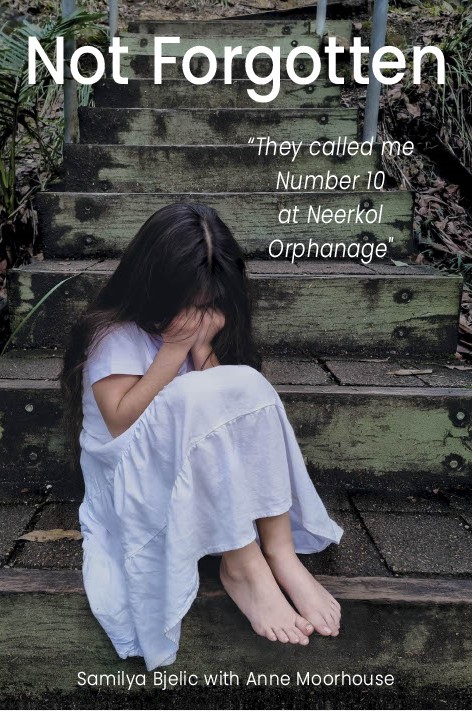
In despair, I sat on the couch late on a Saturday night scrolling through stock photos “I’ll just buy something” I thought. Disappointed that although Samilya and I had both put our hearts into the book, the cover would be impersonal, disconnected from us. That Saturday night I found a picture of a sad girl sitting on a step, “maybe this will do”.
Then I turned to my friend who was staying with me, Peyton Blake. “You take photos of fashion models: do you think you could recreate this photo for me if I get a model tomorrow”. “I can do better than that photo” she responded.
First thing in the morning, I called the young model’s mum with inspiration brewing… “Can I borrow your daughter for a couple of hours, now?” I begged. Thankfully our model was available, and I could see Peyton eyes dancing with creativity and relishing the challenge of bringing our inspiration to life.
Then Peyton realised she was missing the specific memory card she needed to store images on her camera. That tiny memory card was held up in storage due to Covid, as Peyton was only passing through on her travels north. Peyton rang camera stores trying to locate a card but none were available close by. My heart plummeted, more lost time, more delays, did this mean no cover?
Peyton had seen billboard images advertised as being shot by a phone, so she convinced me that she could take the photos on her phone and get the quality we needed for the cover. We arrived at our location, a professional photographer and an apprehensive author, ready to ‘shoot’ using a mobile phone.
A professional photographer, an apprehensive author and a mobile phone on a shoot.
Peyton used her skills and experience to style the model, keeping my concept in mind, and we ventured around the neighbourhood, searching out steps and spaces to capture photos of a sad girl destined for a book cover.
As Peyton captured multiple images, she showed me the photos. She knew I wanted a specific look, but she also knew that it was about an elusive feeling, something that would convey the trauma, isolation and despair of Samilya’s life. The images were beautiful, but nothing quite captivated me…..yet. The model’s mum suggested another location, by this point I was disheartened. I’d almost had enough but reluctantly agreed to one last stop.
The perfect photo for our book cover
This time Peyton took the model a short distance away, and mum and I stood back chatting distractedly in the distance. Peyton believed the model would relax with fewer eyes on her. I believe it was in this quiet, intimate moment that Peyton and the model formed a bond and created the storyline. Then there it was, the perfect photo, of a sad, lonely, traumatised little girl captured empathetically and brilliantly by Peyton. There was no doubt in my mind that Peyton had captured exactly the photo I needed. Thankfully, Samilya wholeheartedly agreed.
Peyton later told me she felt great pride and satisfaction in being able to bring my image to life, knowing Samilya and I could now hold our book in our arms with the burst of pride I had hoped for.
And the model – that’s Samilya’s youngest granddaughter.
Our hearts are full of love, gratitude, delight and pride each time we pass our precious book over to a new owner.
An apology to Forgotten Australians was clearly needed
It’s been 12 years since 11 am on Monday, the 16th of November 2009, when Prime Minister Kevin Rudd apologised to the “Forgotten Australians” and to former child migrants.
As a Forgotten Australian, Samilya only has this one bedraggled photo of herself from her eight horrendous years at St Joseph’s Orphanage, Neerkol. Samilya had yearned for this apology and hoped that her life would be better once it was made. Surely the little girl in the photo deserved an apology, for all the abuse and neglect she had suffered.
The long term impact of a childhood spent in institutional care is complex and varied. However, a fundamental, ongoing issue is the lack of trust and security and lack of interpersonal and life skills that are acquired through a normal family upbringing, especially social and parenting skills. A lifelong inability to initiate and maintain stable, loving relationships was described by many care leavers who have undergone multiple relationships and failed marriages. Many cannot form trust in relationships and remain loners, never marrying or living an isolated existence.
The Senate Committee’s first recommendation was that a national apology be made to the children in institutional care who were its victims.
Sorry – that as children you were taken from your families and placed in institutions where so often you were abused.
Sorry – for the physical suffering, the emotional starvation and the cold absence of love, of tenderness, of care.
Sorry – for the tragedy, the absolute tragedy, of childhoods lost – childhoods spent instead in austere and authoritarian places, where names were replaced by numbers, spontaneous play by regimented routine, the joy of learning by the repetitive drudgery of menial work.
Sorry – for all these injustices to you, as children, who were placed in our care.
I hoped this apology would make a difference
Samilya hoped that this apology, unlike the two other formal apologies she had already received, would make a significant difference to her wellbeing. Samilya was clearly moved but the apology when she blogged the following in the lead up to the national apology:
Today is 4 November 2009. I have forgotten a day but today went well. I finally got out of bed after talking to myself and doing a workout before going to work. That is a choice. But 57 years ago the choices were taken away, and from many others, who were abandoned and put into orphanages. November 16 is sorry day for all of us. It was not about sorry or the money. It was and still is about the truth behind the disadvantaged kids, who are now adults and still misplaced.
A few days after the national apology Samilya wrote again:
Pain is cruel to live by. I lived with pain as a little girl from my abandoned past. Now I would like to die as it is lonely and I am in pain. No wonder the elderly don’t want to live, I have finally come to this point, body pain is horrible how does anyone want to live in a world without love and not knowing love from parents, or family. That was the hardest pain of all.
16th November 2009 was a great day it was the sorry day. It meant a lot as it all finally came out that we were telling the truth. Can anyone describe love and how to be loved by one self? How can you love yourself when you weren’t loved as a child?
I am still forgotten and misplaced
Not long after Prime Minister Kevin Rudd made the apology, Samilya’s view of it changed.
I am now living in the past since going to the third apology night at the state library and I couldn’t go to Kevin Rudd’s one yesterday, I watched it on youtube. It was very painful as I still can’t seem to understand, I have written and emailed before and have gotten no reply and this to me is very confusing, I have gone backward not forward, I missed my psychiatrist appointment due to this, not good. I have to wait now till I see my doctor. Having some kind of faith in any system is very hard for me and for my family to trust. It has affected my daughters in many ways and my sons, I also emailed the Sisters of Mercy about the Royal Commission and all they can say is that they hope this makes families understand, but what about making us understand and why wasn’t this done years ago? Unless you lived in the shoes of us you will never understand or be able to. I would like to add my name to the list for the Royal Commission as I wasn’t heard the last time. So much more needs to be said. I am the one who is still left in limbo and believes in hell and heaven and I will be struck by the devil if I am bad. I have emailed others in the government and no reply so I am still forgotten and misplaced.
Did “sorry” make 2021 better?
Many Forgotten Australians are still awaiting payments through the National Redress Scheme which was established after the Royal Commission into Institutional Sexual Abuse concluded in 2013. The Redress Scheme offers payments of up to $150,000 but the average payment is only $80,000 and the process is slow, arduous and for many who apply, re-triggering of their trauma. There has been no similar scheme for F0rgotten Australians who were not sexually abused, but who were violently abused and neglected.
Forgotten Australians have petitioned for a Health Care Card for medical and dental care for all Forgotten Australians. The card would provide ease of access to health care and government services similar to the Gold Card for Veterans. The petition seems to have lost impetus despite having almost 7,000 signatures and can be found here:
 My gorgeous grandson, Leo, was surrounded by his adoring great-grandfather, grandfather and father. The love for him radiated from these three men. Watching them, I wondered how the experience of becoming a dad had shifted across the three generations.

 Three generations of men becoming dads, three very different worlds, and one shared moment: holding their newborn child for the first time.
 Tall Black — my majestic, caffeine‑fuelled, eco‑friendly giraffe — now stands proudly in the garden, shimmering in the sun in his coat of repurposed coffee pods. He’s tall, he’s colourful, and he’s a daily reminder that creativity (and a little community spirit) can turn discarded bits and pieces into something unexpectedly joyful.
 I knew my giraffe needed a new coat — something fun, something colourful, something that would bring him back to life. Coffee pods suddenly seemed perfect.
 Transforming thousands of coffee pods into a giraffe coat is not for the faint‑hearted. Here’s the process I perfected (or maybe endured):
 Now Tall Black stands in the garden, shimmering with colour, personality, and a touch of mischief. He’s become a conversation starter, a sustainability ambassador, and a daily reminder that beauty can come from the things we usually throw away.
 Tall Black has been such a joy that I’m itching for another challenge. Maybe a dragon. Maybe a peacock. Maybe something I haven’t even imagined yet.

 The oldest boy is my great-nephew. He is my sister’s grandson, visiting from New Zealand with his parents for a lovely long weekend of family connection and to join our annual Christmas Carols extravaganza. I visited my sister in New Zealand in January 2025. At 79 years old, she was living at home with her husband, and while she seemed somewhat withdrawn and a little confused, life was much like it had been for many years. I had an underlying sense of disquiet and gently encouraged her to
  An ordinary day, but not an ordinary moment. It’s a moment heavy with meaning—a snapshot of family history, love and loss. A moment that rewards every effort to show up for these children, and honours the trust their parents place in us. A moment that whispers: This is what matters.
 This month, I’ve spent hours talking with friends and family about getting old and dying. It’s such a fun topic when you’re on holiday. Yet, discussing ageing and death is now part of the narrative of my life. At 68, if the media interviewed me, I would be considered an “elderly retired grandmother”. Not that I feel like that. When I was a young mum, I talked about babies and toddlers. Then I lamented with anyone who would listen about wayward teenagers. After those teenagers became adults and left, I discussed work. Now that I’m retired many conversations are around planning holidays, grandchildren, the state of the world, getting old, and death. It’s a bit like the
  My 92-year-old father-in-law and 90-year-old mother-in-law live independently in their family home. They have made some alterations like adding a step elevator for the front steps and installing grab rails and a bidet in the bathroom. They have help in the garden and a cleaner. Their home remains perfect for them, close to family and the community they have lived in all their lives. However, I decided I needed to move after falling down my
  It’s unimaginable that I won’t be able to make decisions for myself, but I have seen the consequences of not planning for this possibility. At 65 years old, a friend had a stroke and was unable to make decisions for himself. After an initial hospital stay, he was moved to an aged care home. His family and friends had to make an application to the Guardianship and Administration Tribunal, so a guardian to manage his affairs could be appointed. Until this happened no major decisions could be made about his assets, and funds needed for his care were limited. My friend also had to be medically assessed as not having the capacity to make important health and personal decisions as evidence for the tribunal. These stressful and lengthy medico/legal processes would have been avoided had he prepared an Enduring Power of Attorney when he was well.
  We all have “stuff”. It seems to accumulate no matter how many clean-outs we have. Some of that “stuff” is valuable, like your home, financial investments and other assets. I’m sure family and friends will select sentimental mementos when I’m gone, but they won’t want most of my chattels and I’m ok with this. However, although I plan to spend as much of my money as I can before I die, I do want to choose who will receive any remaining financial assets. The best way I can ensure this will happen as I wish is to make a Will.


 Leo lifts the brass latches of the 100-year-old cabin trunk, opens the lid and climbs inside. At 18 months old Leo is unaware that the trunk belonged to his great-great-grandmother Purthanry Thanes Mary Cutts. While he explores, I run my hands gently over the aged leather lid and embellished corners, allowing myself to daydream of luxurious travel aboard a grand cruise liner.
 I met Purthanry, my husband’s paternal grandmother when I was 30 and she was in her 80’s. Like the trunk, she had an aura of elegance and sophistication which I found somewhat intimidating even as she welcomed me warmly into the family. I was unaware of the trunk until after her death. Then I coveted it. The trunk is a precious family heirloom and a connection to my
  Purthanry had returned home by 1928 when she married Frank Moorhouse at 27. Purthanry, a Girl Guide Captain, and her Guides, approached Frank at Mosman ferry wharf while selling tickets to a ball. Initially Frank refused the tickets as he did not have a partner, however, the resourceful Guides assured him they could organise the perfect date. Purthanry and Frank attended the ball together.
 The couple moved to East Street, Nowra, living in a home they called Amaroho. Some of Purthanry’s first acquisitions were a beautiful dressing table and chamber pot commode cupboard which stayed with Purtharny until her death at 95. When I received the cabin trunk, my son and his English wife took possession of the dressing table and cupboard which are now part of Leo’s daily life. Arthur remembers his mother brushing her long hair at the dressing table. She always tied her hair up in a bun. Purthanry dressed formally with minimal makeup and never wore trousers or shorts.


 Frank Moorhouse was on the periphery of my life.
 Connecting with Frank Moorhouse
 Franks Memorial
 yton later told me she felt great pride and satisfaction in being able to bring my image to life, knowing Samilya and I could now hold our book in our arms with the burst of pride I had hoped for.