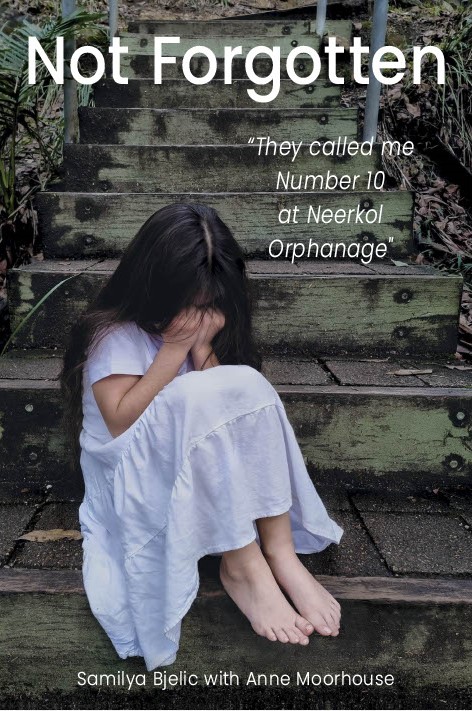
Eight long, long years ago we started writingNot Forgotten: They called me Number 10 at Neerkol orphanage. Now I can reveal that Not Forgotten is the biography of Samilya Bjelic, who is referred to in past posts as Ms Forgotten Australian. We had to do this as there were current legal matters which meant we could not disclose her identity. We were silenced for two years. I swore and ranted against this suppression, yet the legal team assured me it was in Samilya’s best interest. For the first time, I felt my voice silenced by the Catholic church, for Samilya it was a repeat experience. Endured multiple times throughout her life.
Yet now here we are, free from legal constraints and tantalisingly close to having the book in our hands. This week, Covid-19 lockdowns permitting, Samilya and I will pick up our first copies.
So let me introduce you to Samilya Bjelic. She is an extraordinary woman who has endured more than most in her lifetime. She is a Forgotten Australian, volunteer, activist, mother, grandmother, friend. You will only really know and understand why she is my hero after you read Not Forgotten: They called me Number 10 at Neerkol Orphanage.
Stay posted, Not Forgotten: They called me Number 10 at Neerkol orphanage will soon be released!
Samilya and I are so excited to finally be able to share this with you. It’s been a long and difficult journey but we’ve shared some tea and laughs along the way.
The end is tantalisingly near. I can almost feel the weight of the book in my hand and smell the print on the page. This eight-year journey of narrating Ms Forgotten Australian’s biography has been much longer than I expected. We’re not quite there yet and I feel so impatient! I’ve sat with frustration and a sense of injustice as we were delayed by legal matters. I’ve struggled to harness my patience while those who matter needed time to reflect on the impact the book would have on them. I’ve been exhausted and bored by the seemingly endless hours of work. Now, as we get much closer to having a book, alongside excitement I feel the bubbling cesspit of anxiety and fear.
Self-doubt makes an appearance
My mind wanders to thoughts like “What if people tell me the book is terrible?” “What if no one reads it” “Who am I to think I can write a book?” “What if my peers, or clients, think I’m an awful psychologist?” “What if there are mistakes I haven’t found?” “What if I’ve misrepresented Ms Forgotten Australian?” “Self-publishing is not the same as being a real author!”
We all experience self-doubt but I refuse to allow self-doubt to ruin this time for me. I was musing over how to manage these thoughts and feelings when a client mentioned the Man in the Arena quote by Theodore Rosevelt and a talk on the topic by Brene Brown.
The woman in the arena
It is not the critic who counts; not the woman who points out how the strong woman stumbles, or where the doer of deeds could have done them better. The credit belongs to the woman who is actually in the arena, whose face is marred by dust and sweat and blood; who strives valiantly; who errs, who comes short again and again, because there is no effort without error and shortcoming; but who does actually strive to do the deeds; who knows great enthusiasms, the great devotions; who spends herself in a worthy cause; who at the best knows in the end the triumph of high achievement, and who at the worst, if she fails, at least fails while daring greatly, so that her place shall never be with those cold and timid souls who neither know victory nor defeat.
Theodore Roosevelt (of course he wrote it about a man… but I like it better about a woman)
Invite your critics into the arena
The quote resonated with me. I am about to step into the arena. I will be vulnerable and exposed as I present the best of me to the world in the form of a book. Why wouldn’t I feel some fear? There will always be critics in the audience, both real and imagined. Brene urges us to reserve a seat for the four critics who will undoubtedly turn up.
Shame – the universal feeling that we all experience. As a critic, it tells you you are not good enough.
Scarcity – This critic tells you that what you are doing is not original, that there are better educated, trained and articulate people than you. That what you are doing does not matter.
Comparison – it’s the death of joy. My comparison critic will undoubtedly tell me I should not even mention the name, Brene Brown alongside my own.
Yourself – the critical internal voice with its familiar messages, known only to you.
So come on in critics and take a seat up the front. You will not tell me anything I haven’t already thought of. You are so familiar. I will see you and I will hear you but I will continue. I am ready. I will dare greatly. I will step into the arena and if I falter, as I may…I can always watch Brene Brown again, pick myself up and continue.
Today, 13/3/2018, Cardinal Pell received a maximum sentence of six years for the sexual abuse of two teenage boys, after Sunday mass at St Patrick’s Cathedral in 1966. He will be eligible for parole in three years and eight months.
While handing down the sentence Chief Judge Peter Kidd said Pell been “breathtakingly arrogant” and “brazen and callous” in his offending.
That Australia’s most senior Catholic leader has been found guilty of child sexual assault astounds me. No longer is the Catholic church successful at covering up its heinous deeds.
Pell is now guilty and imprisoned. It’s likely that others who have been sexually abused as children, and who have remained silent, may now be considering legal action against their perpetrators. Before you embark on a marathon legal journey, read Survivors and Solicitors, and make sure you have a strong team with you.
Original Post 8 May 2018.
Cardinal George Pell, Australia’s most senior Catholic leader, was committed to stand trial for Continue reading →
Through the Redress Scheme, those who have been sexually abused in Australian institutions now have the opportunity to obtain financial compensation, counselling and a personal apology for the horror they endured. But don’t for one minute think it will be an easy process.
On 14 September 2015 the Australian Royal Commission into Institutional Responses to Child Sexual Abuse released its Redress and Civil Litigation Report. After receiving submissions from more than 250 individuals and institutions, the 589-page report made 99 recommendations. There was an enormous financial cost to the Australian public for the Royal Commission so we should listen to what the Royal Commission had to say.
Here are some of the most significant recommendations regarding the Redress Scheme and what’s happened so far: Continue reading →
Vulnerable Forgotten Australians need your care and assistance. If you work at Centrelink, the police, for an employment services provider, deliver health care, work in a hospital or an aged care facility it’s essential you understand that some Forgotten Australians have a history of abuse and neglect, which continues to impact on their lives and current needs.
Who are the Forgotten Australians?
The term Forgotten Australians was first used by the Australian Senate in its 2003–2004 report, Inquiry into Children in Institutional Care. This dismal label described a group of 500,000 children who were institutionalised between 1920 and 1970. These children grew up in State, church and charity run orphanages and homes where many of them were neglected, exploited and brutalised. The term now also refers to those who were in out-of-home care until the end of 1989. As many of these people have had families, it is highly likely that every Australian either was, or is related to, works with or knows someone who is a Forgotten Australian.
The Forgotten Australians are not a homogenous group and not all Forgotten Australians require the same level of assistance. Some were placed in care arrangements where they were nurtured and well looked after, others, however, experienced horrendous events where they were abused repeatedly throughout their childhood. Many Forgotten Australians have raised families, completed education, had successful careers, volunteered in the community, and own homes. However, others remain some of our most vulnerable citizens, struggling with physical and mental health conditions and challenged to maintain accommodation, relationships and employment.
It is the vulnerable and traumatised group of Forgotten Australians that require compassionate care and support when accessing services.
Clients often experience a wave of relief after their first counselling session. Their burden is shared and they feel joined on their journey. That old saying, a worry shared is a worry halved rings true.
Sometimes, you don’t recognise how burdened you’re feeling until the load eases, as I experienced recently. I’d been working on Ms Forgotten Australian’s biography for over four years and had come to the end of my skills, capability, and motivation. I knew I had to do more but had no idea Continue reading →
Writing the biography of Ms Forgotten Australian led me into a foreign world, one of abusive Catholic clergy and the ominous power of the Catholic Church. Ms Forgotten Australian spent her childhood in the now infamous St Joseph’s Orphanage, Neerkol. Sadly her time there included child sexual abuse by priests and systemic cover-up by the Church.
In May 2018 Archbishop Phillip Wilson was convicted of the cover-up of sexual abuse of altar boys. Priest Jim Fletcher abused the boys in the Hunter Region of New South Wales during the 1970’s. Last month Magistrate Robert Stone found Wilson guilty of concealing a serious indictable offence of another person. This is a landmark Australian case due to the precedent it set. The conviction Continue reading →
A parent abuses a child, yet that same parent is also responsible for feeding and sheltering the child. Fear of retribution deftly silences the child. No adults are seen as safe.
Condemnation and punishment await an unruly and antisocial boy, who has no words to describe his chaotic emotional world or the abuse he is experiencing. Opportunities for disclosure are lost.
A teenage girl internalises her shame, silenced by the myth of the perfect family. No one would believe what happens in her family. The self-inflicted slashes on her thighs scream her pain, but no one hears. Continue reading →
I’m writing my dear friend’s biography, which has the working title of Not Forgotten. It’s been a labour of love, but often, more like hard dull labour than passionate love. I have felt like a pregnant elephant, holding this huge story deep inside me for the longest time. But elephants only gestate for two years, and this book has been in production for over four years. I now know that four years is not unusual for a book. The process seems endless – interview, research, write, get feedback from readers, edit, interview more people, write, get more feedback from readers, edit. Repeat multiple times. Then become overwhelmed by the enormity of the task, drown in self-doubt, pick yourself up and get going again.
I blogged in 2015 for a year. The purpose was to hone my writing skills while my husband Steven and I enjoyed six restorative months away from our busy lives, travelling the world. Those posts are still here, now mostly irrelevant, but I can’t bear to delete them. Since then I have continued to work on Not Forgotten. Now I’m firing up the blog again to motivate me through the final stages of labour – getting it from a manuscript to publication.
During the gestation period Not Forgotten has led me to thought-provoking places; the magnificent State Library of Victoria, an orphanage for critically ill children in China, a psychiatrist’s room, a rock climbing expedition and decaying buildings in Far North Queensland. I have become the keeper of my friend’s family history, with cupboards overflowing with documents, diaries and photos of people I do not know. My life has been enriched by the growth of a cherished friendship.
Recently we went to the launch of Be Enterprise, an innovative social enterprise program of Logan Women’s Health and Wellbeing Centre. The evening combined the launch of the program with a healthy amount of fund raising. The invitation to attend had been extended to me by Liz Irvine, Chair of the Board, and since I’d had a role in her being on the board in the first place it was an offer I really couldn’t refuse.
It’s been a long time since I’ve been to a women focused event and it was great to step outside my normal routine. I felt recharged after the night as I listened to women with conviction and passion speak about the work they do to make a difference to women’s lives.
Shannon Fentiman MP – Minister for Communities, Women and Youth, Minister for Child Safety, Minister for Multicultural Affairs and Member for Waterford reminded us that the gender pay gap is still alive and well, with woman being paid, on average, 17% less than men. I thought of a recent conversation Continue reading →
 Not Forgotten: They called me Number 10 at Neerkol orphanage. Now I can reveal that Not Forgotten is the biography of Samilya Bjelic, who is referred to in past posts as Ms Forgotten Australian. We had to do this as there were current legal matters which meant we could not disclose her identity. We were silenced for two years. I swore and ranted against this suppression, yet the legal team assured me it was in Samilya’s best interest. For the first time, I felt my voice silenced by the Catholic church, for Samilya it was a repeat experience. Endured multiple times throughout her life.


 The quote resonated with me. I am about to step into the arena. I will be vulnerable and exposed as I present the best of me to the world in the form of a book. Why wouldn’t I feel some fear? There will always be critics in the audience, both real and imagined. Brene urges us to reserve a seat for the four critics who will undoubtedly turn up.

 Cardinal Pell Sentenced!


 Clients often experience a wave of relief after their first counselling session. Their burden is shared and they feel joined on their journey. That old saying, a worry shared is a worry halved rings true.

 Writing the biography of

 Victims voices and